Resolving React Query Issues
, 2 min, react-query
We describe the merge process by resolving one issue in React Query.
, 2 min, react-query
We describe the merge process by resolving one issue in React Query.
This article describes the experience of resolving performance issues in React Query.
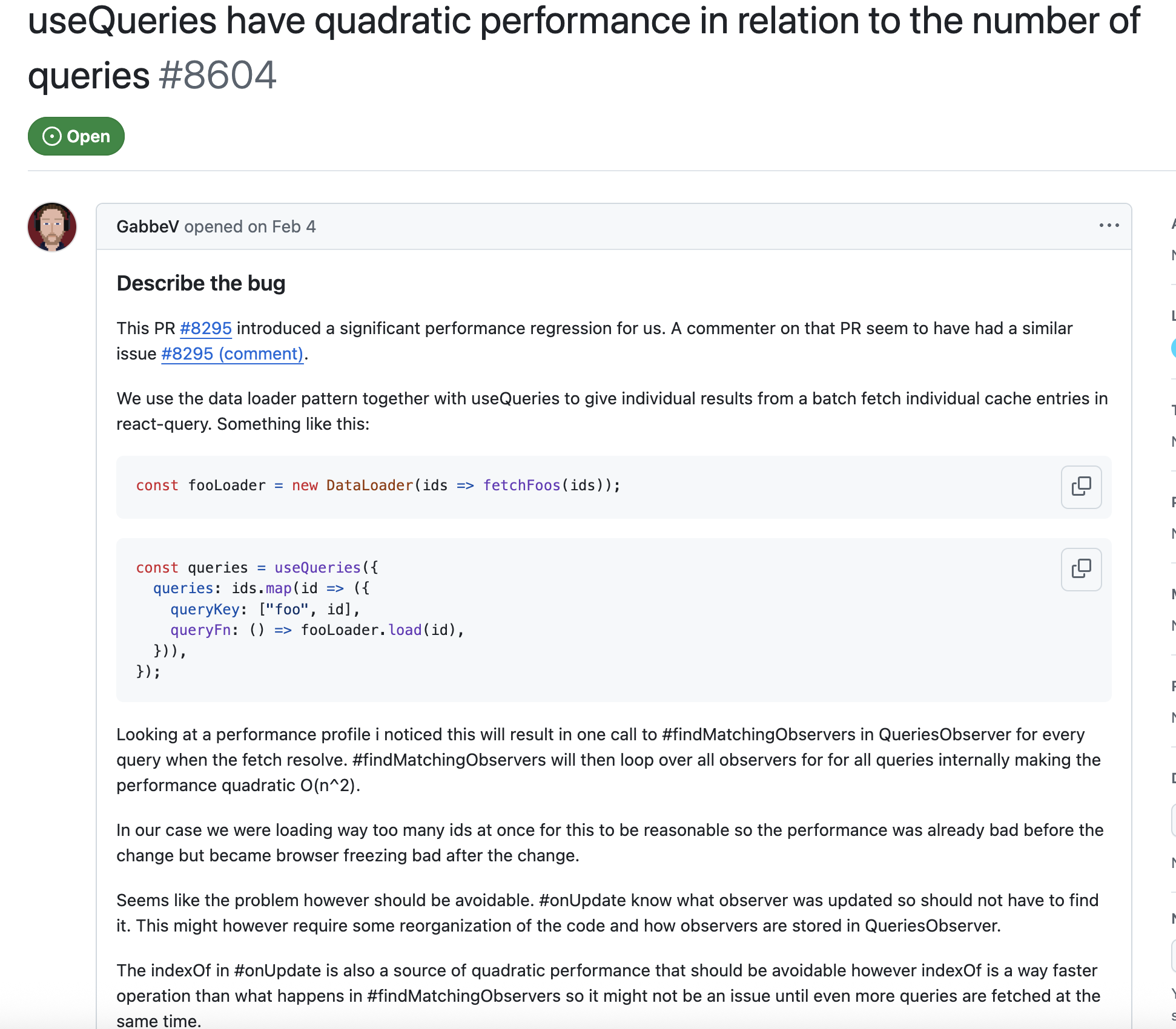
Issue: An issue that points out a problem with the internal logic of useQueries and specifically mentions that there is a problem with traversing n queries n times → O(n²).
To be precise, the problem is as follows.
// Assume idx = [1, 2, 3, 4, 5]
const userLoader = new DataLoader(async (ids) => {
  const users = await fetch(`/api/users?ids=${ids.join(',')}`);
  return users; // [user1, user2, user3, user4, user5] returned at once
});
// Inside DataLoader
promise1.resolve(user1); // As the first query in useQueries
promise2.resolve(user2); // As the second query in useQueries
promise3.resolve(user3); // With the third query of useQueries
// ...
// Whenever each Promise is resolved
user1 arrives → observer1 is updated → findMatchingObservers() is executed → all observers are traversed
user2 arrives → observer2 is updated → findMatchingObservers() is executed → all observers are traversed
user3 arrives → observer3 is updated → findMatchingObservers() is executed → all observers are traversed
// ...
Delivery driver brings 100 packages

1st courier delivery
- Search for delivery locations: Building 101 -> Building 102 -> Building 103 -> ... -> Building 200 (check all 100 buildings)
- Finally, it was located in 101-dong and delivery was completed.

2nd courier delivery
- Search for delivery locations: Building 101 -> Building 102 -> Building 103 -> ... -> Building 200 (check all 100 buildings)
- Finally, delivery was completed after finding 102-dong.

Repeat this 100 times

Total number of confirmations: 100 parcels × 100 units = 10,000 times
After understanding the above problem and looking at the code, I thought there were two problems.
// Because array2.includes(x) is called for every element,
// Even if prevObservers <-> newObservers are almost identical, both arrays are scanned interchangeably.
// Even if an observer already exists, the includes linear search is repeated every time.
function difference<T>(array1: Array<T>, array2: Array<T>): Array<T> {
  return array1.filter((x) => !array2.includes(x)); // O(n²) complexity
}
// EX: A situation where there are 100 observers and only 1 has changed.
prevObservers = [obs1, obs2, obs3, ..., obs100];
newObservers = [obs1, obs2, obs3, ..., obs99, obs101]; // obs100 → changed to obs101

// difference(prevObservers, newObservers)
// obs1: Check all 100 newObservers → Yes
// obs2: Check all 100 newObservers → Yes
// obs3: Check all 100 newObservers → Yes
// ...
// obs100: Check all 100 newObservers → None -> Target for removal

// Total operations: 100 × 100 = 10,000 times
#onUpdate(observer: QueryObserver, result: QueryObserverResult): void {
// I already know what to update with the observer parameter, but I search the whole thing again with indexOf.
  const index = this.#observers.indexOf(observer)
  if (index !== -1) {
    this.#result = replaceAt(this.#result, index, result)
    this.#notify()
  }
}
  #trackResult(
    result: Array<QueryObserverResult>,
    queries: Array<QueryObserverOptions>,
  ) {
	  // Repeat findMatchingObservers each time
    const matches = this.#findMatchingObservers(queries)

    return matches.map((match, index) => {
      const observerResult = result[index]!
      return !match.defaultedQueryOptions.notifyOnChangeProps
        ? match.observer.trackResult(observerResult, (accessedProp) => {
            // track property on all observers to ensure proper (synchronized) tracking (#7000)
            matches.forEach((m) => {
              m.observer.trackProp(accessedProp)
            })
          })
        : observerResult
    })
  }
At that time, we only identified one problem out of three trouble codes.
  #trackResult(
    result: Array<QueryObserverResult>,
    matches: Array<QueryObserverMatch>,
  ) {
    return matches.map((match, index) => {
      const observerResult = result[index]!
      return !match.defaultedQueryOptions.notifyOnChangeProps
        ? match.observer.trackResult(observerResult, (accessedProp) => {
            // track property on all observers to ensure proper (synchronized) tracking (#7000)
            matches.forEach((m) => {
              m.observer.trackProp(accessedProp)
            })
          })
        : observerResult
    })
  }
In order to avoid having to do findMatchingObservers every time in trackResult, I declared observerMatches and saved the result of findMatchingObservers.
// Old code: not saving it after finding it
const newObserverMatches = this.#findMatchingObservers(this.#queries);

// Improvement Code: Find and save to improve for future use.
const newObserverMatches = this.#findMatchingObservers(this.#queries);
this.#observerMatches = newObserverMatches;
I posted the modified PR, but the person who first presented the issue gave feedback as below.
Looking at the code myself and at your PR @joseph0926 I realized that this will be quite hard to solve entirely. Your PR does remove some quadratic work but onUpdate still contain the mentioned indexOf, trackResult still contain a map over all observers, any user defined combine method will most likely also do N amount of work and if not combineResult will in replaceEqualDeep.

What fundamentally makes multiple useQuery faster than useQueries is reacts auto batching. We notify react once for each updated useQuery but react only rerender once.

I thought that maybe we could do the same for useQueries by notifying useSyncExternalStore on every update and doing combineResult/trackResult lazily when react request the value in getSnapshot. However it seems like react will call getSnapshot every time it is notified defeating this idea.
In short, it seems to be saying that although performance may improve slightly, the fundamental problem does not seem to have been solved.
I couldn't pinpoint what the underlying problem was at the time, so I stopped fixing it here.
However, the original author of React Query decided that this level of performance improvement was meaningful and proceeded with the merge.
In the months since, many issues have improved.
-Improved difference
function difference<T>(array1: Array<T>, array2: Array<T>): Array<T> {
  const excludeSet = new Set(array2);
  return array1.filter((x) => !excludeSet.has(x));
}
#findMatchingObservers(queries: Array<QueryObserverOptions>): Array<QueryObserverMatch> {
  const prevObserversMap = new Map(
    this.#observers.map((observer) => [observer.options.queryHash, observer]),
  )

  queries.forEach((options) => {
    const match = prevObserversMap.get(defaultedOptions.queryHash)
    // ...
  })
}